D20 History
A need for standardized definitions of terms and data definitions for traffic safety, was identified as early as 1922, when National Safety Council published standard police and driver accident report forms. A number of standards developed over the years, but they were not always consistent with each other.
With the introduction of computers in the 1960s it became apparent there was a need for standardized data definitions to enable the efficient sharing of data. The Highway Safety Act of 1966 (23 USC �148), required states receiving federal highway safety funds to develop better systems for collecting and processing Traffic Records to be used in operating safety programs. Traffic Records in this context refer to records related to motor vehicle registration, driver licensing, highway design and operations, crashes, financial responsibility, motor vehicle inspection, commercial vehicle reciprocity, traffic law enforcement, emergency medical services, etc.
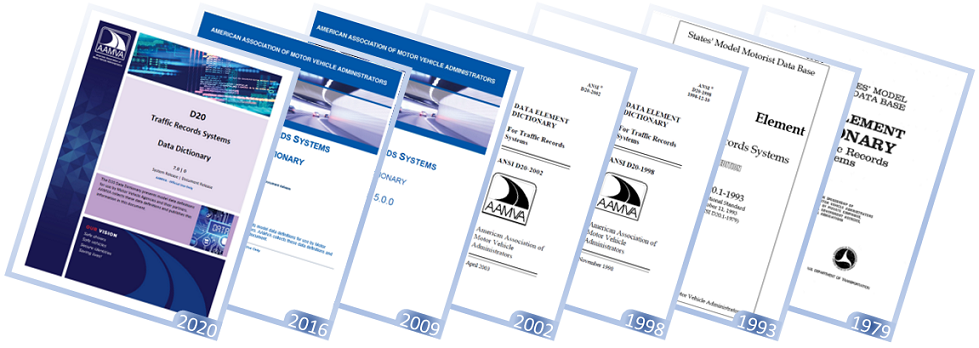
First Edition - With funding and computer services provided by NHTSA and FHWA and under the leadership of AAMVA, several hundred persons from more than eighty public and private organizations participated in compiling the dictionary. The deliverables from this effort are Dl6.1 Manual on Classification of Motor Vehicle Traffic Accidents and D20 States' Model Motorist Data Base. The D20 work on specific tasks was delegated to the sub-committees:
D20.1 - Data Directory Technical Committee
D20.2 - Vehicle Data Technical Committee (which built on the work of the ANSI D19 Vehicle Procedures committee).
D20.3 - Driver Data Technical Committee
D20.4 - Highway Data Technical Committee
D20.5 - Accident Data Technical Committee (extending the ANSI D15, D16 and D17 standards).
D20.6 - Financial Responsibility Data
D20.7 -Vehicle Inspection Data (extending the ANSI D7 and D18 standards).
D20.8 - Reciprocity Data
D20.9 - Communications Systems and Data Exchange
D20.10 - Model Motorist Data Base Design
D20.11 - Traffic Enforcement and Adjudication
D20.12 - Emergency Medical Services
D20.13 - Traffic Safety Management Data Committee.
The areas covered by the sub-committees are reflected in the content covered by dictionary. The first edition of the dictionary was issued in 1979 as American National Standard ANSI D20.1-1979.
The D20 Parent Committee was dissolved and responsibility for the maintenance of the D20 dictionary was transferred to AAMVA’s Standing Committee on Motor Vehicle Information Systems (MVIS) after a 1984 ballot of the D20 Parent Committee. On May 6, 1986, MVIS formally submitted a request to ANSI that AAMVA be accredited as the sponsor charged with maintenance of the D20 Dictionary. In a letter dated August 28, 1986, ANSI notified AAMVA by that the request was approved.
Second Edition - A second edition of D20 was approved on October 11, 1993 by the American National Standards Institute as ANSI Data Element Dictionary for Traffic Records Systems D20.1-1993. In the second edition, many data elements were updated for greater compatibility with current operating data systems.
Third Edition - The third edition was published in 1998 as the Data Element Dictionary for Traffic Records Systems, ANSI D20-1998. Many of the data definitions for Roadway and Accident data were removed from D20 because they were being managed by other organizations who had active subject matter experts. Also the conviction and withdrawal violation codes (sometimes called ANSI Codes) were separated off and became the AAMVA Code Dictionary (ACD).
The D20-1998 edition, synchronizes the Dictionary with the AAMVA data repository. The AAMVA repository was developed using as a source of reference, the different AAMVA Electronic Data Interchange applications used by the AAMVA community on a national basis. These applications encompass the driver licensing, vehicle registration and titling, and motor carrier registration business areas of the U.S. and Canadian Departments of Motor Vehicles. It is important to note that most of these applications were initially developed using D20 as a reference. New elements were created in the AAMVA repository only if the data elements did not meet the application's exact requirements.
Fourth Edition - The fourth edition was published in April 2003 as the Data Element Dictionary for Traffic Records Systems, ANSI D20-2003. This was a minor revision, it only introduced a few updates, which were needed to keep some element definitions current with their revised uses.
Fifth Edition - The fifth edition was published in May 2009 as the Data Element Dictionary for Traffic Records Systems, ANSI D20-2009. This is a minor revision, it only contained a few updates, which were needed to keep some element definitions current with their revised uses.
Sixth Edition - The sixth edition was published in 2016 and was published without ANSI accreditation and the ANSI label have also been dropped.
When D20 was first established, the ANSI process for developing standards through consensus was selected. The ANSI name not only provided a respected label, but also provided a mechanism for creating a standard that supports data definitions used across Industry, Federal and Jurisdictional organizations. Since it was created, D20 has lagged behind the latest data definition standards and new editions merely introduced updates which were already widely in use. This was a result of the drivers of updates not being able to accommodate the ANSI process, which resulted in D20 just collecting and publishing previously approved changes. AAMVA dropped the ANSI process with the aim of allowing D20 to be updated more frequently so it can reflect data definitions currently being used.
The business applications and services that AAMVA provides support the exchange of driver and vehicle data, but not the exchange of accident/crash and roadway data. As a result, AAMVA has been unable to keep the D20 updated with this type of information. AAMVA has therefore acknowledged this limitation by restricting the scope of the D20 content so that this new edition and all futures editions will no longer include data definitions for accident/crash and roadway data. This edition also contains a few updates, which were needed to keep some element definitions current with their revised uses.
A minor revision was published in 2017, as release 6.1. It contained a few updates, which were needed to keep some element definitions current with their revised uses.
Seventh Edition - This edition was published in 2020. Besides the update to reflect revised definitions, the definitions of data used in CDL Tests (Driving Test, Examiner & Test Organization) by CSTIMS and ROOSTR applications was added.
Eighth Edition - This edition was published in 2023. It includes updates to reflect current business definitions. To support current technologies, two copies of D20 are now available. The AMIE version is a continuation of the earlier editions of D20. A new JSON version of D20 is now also available, which presents data formats more suited to technologies like web-services.
Earlier release of the document contained group elements with the sub-elements separated by spaces. The space separated sub-elements, is not a practice used in current systems. So updates were also made to these group fields to support their use in JSON data definitions.
A minor revision was published in late 2023 (as release 8.1), which brought the MCO definitions up to date. Another minor revision was released in 2025 (as 8.2) with a few new Citation and Vehicle Sale elements.
|
AAMVA.org Who is AAMVA Contact AAMVA (helpdesk@aamva.org) System Availability |
AAMVA Terms of Service AAMVA - Official Use Only 2/18/2026 © AAMVA. All rights reserved. Book: 56261 Topic: 19886 |