Vehicle / Hull ID Number
Source of Definition: SAE; NHTSA; D20/79; 49 CFR 565; 49 CFR 567; 33 CFR 181.25

Source of Data: Vehicle (vessel) manufacturer; Commercial vehicle cab card; Labels on the vehicle
Synonyms: VIN; HIN; Serial number; Motor number; Chassis number; Hull number
A unique combination of alphanumeric characters that identifies a specific vehicle or vessel. The VIN is affixed to the vehicle in specific locations and formulated by the manufacturer. State agencies under some controlled instances may assign a VIN to a vehicle. This field is left justified and is large enough to accommodate VINs created before the VIN format was standardized:
- Land vehicles, have used a 17 character VIN, since 1982. See NHTSA Title 49 CFR 565 for the format and procedures. Most VINs issued before 1982 were 17 characters or less, but some U.S. truck manufacturers used longer numbers.
- Vessels, since 1973 vessels should have used a 12 character VIN. See 33 CFR 181.25 for the format and procedures.
Logical Format (Type/Max Length): AN/30
VVHIDN
VIN Location
The VIN is affixed to the vehicle in specific locations and formulated by the manufacturer. The most common location is on the top of the dashboard, positioned so it can be read through the windshield. Some manufacturers affix the VIN to the vehicle in multiple locations.
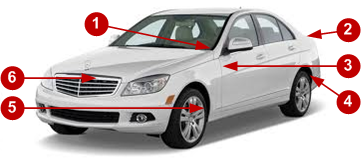
- Top of dashboard on driver side, visible through windshield.
- Trunk, under spare tire.
- Driver door jam, visible when door open, per 49 CFR 567.4(g)(6);
- Back wheel well
- Stamped on front end of frame
- Front of engine block
The VIN is also recorded on a vehicle's title, registration, guarantee/maintenance book and on the declarations page of an auto insurance policy.
VIN 17-Character Format
In 1982, National Highway Traffic Safety Administration (NHTSA) established a standard format for Vehicle Identification Numbers (VINs). Below is a synopsis of the standard. For the official description, see NHTSA Title 49 CFR 565.
The characters used in a VIN are:
ABCDEFGHJKLMNPRSTUVWXYZ0123456789Standard 17-character VINs have the following format:
Position |
Description |
Group |
|---|---|---|
1 |
Country where manufactured |
World Manufacturer Identifier
|
2-3 |
Manufacturer and make or model |
|
4-8 |
Vehicle description |
Vehicle Descriptor Section
|
9 |
Check digit |
|
10 |
Year manufactured |
Vehicle Identifier Section
|
11 |
Assembly plant |
|
12-17 |
Serial or sequential number |
Position 1, country where manufactured, is a code assigned by the Society of Automotive Engineers (SAE). The most common alphanumeric codes are listed below. Additional codes may be added when needed by a new or existing country.
1 |
U.S.A. |
K |
Korea |
2 |
Canada |
L |
Taiwan |
3 |
Mexico |
S |
U.K. |
4 |
U.S.A. |
V |
France |
5 |
U.S.A. |
W |
Germany |
6 |
Australia |
Y |
Sweden |
9 |
Brazil |
Z |
Italy |
J |
Japan |
|
|
Positions 2 and 3, manufacturer and make or model, is an alphanumeric code assigned by the SAE.
Positions 4-8, vehicle description, are codes assigned by the manufacturer. The format of the description is broken down by vehicle type. The format of each is described using 'A' (alphabetic), '9' (numeric) and 'X' (alphanumeric).
Type |
Format |
4 |
5 |
6 |
7 |
8 |
|---|---|---|---|---|---|---|
Passenger Cars |
AA99X |
Restraints |
||||
Multi-purpose passenger vehicle |
AA99X |
Line |
Series |
Body type |
Engine type |
|
XXXXX |
Line |
Series |
Body type |
Engine type |
Braking system |
|
XXXXX |
Line |
Series |
Cab type |
Engine type |
Braking system |
|
Truck of 10,000 lbs. or less |
AA99X |
Line, series and/or model |
Cab type, chassis and/or engine type |
Brake system and/or GVWR |
||
Truck over 10,000 lbs. |
XXXXX |
Line |
Series |
Cab type, chassis and/or engine type |
Brake system and/or GVWR |
|
XXXXX |
Trailer type |
Body type |
Length |
Axel confg. |
|
|
XXXXX |
Motorcycle type |
Line |
Engine type |
Horsepower |
|
|
Position 9, check digit, contains either a number or 'X'. The check digit matches the value calculated from the rest of the VIN. The check digit is calculated as follows:
1. Convert any letters to numbers
Letter: A B C D E F G H I J K L M N O P Q R S T U V W X Y Z
Number: 1 2 3 4 5 6 7 8 9 1 2 3 4 5 6 7 8 9 2 3 4 5 6 7 8 9
2. Multiply the number derived from each column by a weighting factor. The factors are:
Position: 1 2 3 4 5 6 7 8 - 10 11 12 13 14 15 16 17 Factor: 8 7 6 5 4 3 2 10 - 9 8 7 6 5 4 3 23. Add the resulting products and divide by 11.
4. The remainder is the check digit. If the remainder is 10, the check digit is 'X'.
Position 10, year manufactured, is a code that is repeated every 30 years. The codes are:
A |
1980, or 2010, or 2040, or 2070, etc. |
S |
1995 |
B |
1981 |
T |
1996 |
C |
1982 |
V |
1997 |
D |
1983 |
W |
1998 |
E |
1984 |
X |
1999 |
F |
1985 |
Y |
2000 |
G |
1986 |
1 |
2001 |
H |
1987 |
2 |
2002 |
J |
1988 |
3 |
2003 |
K |
1989 |
4 |
2004 |
L |
1990 |
5 |
2005 |
M |
1991 |
6 |
2006 |
N |
1992 |
7 |
2007 |
P |
1993 |
8 |
2008 |
R |
1994 |
9 |
2009 |
Position 11, assembly plant, is an alphanumeric code assigned by the manufacturer.
Position 12-17, serial or sequential number, is assigned by the manufacturer. Positions 12 & 13 are alphanumeric and 14 to 17 are numeric.
HIN 12-Character Format
In 1973, the USCG (in 33 CFR 181.25) established a standard requirement for Hull Identification Numbers (HINs).
HINs issued from 11/1/1972 till 7/31/1984 should have the following format:
Position |
Description |
|---|---|
1-3 |
Manufacturer: per 181.31(b). |
4-5 |
|
6-8 |
Hull number |
9-11 |
Model Year |
12 |
Month: A=Aug, B=Sep, to L=July |
HINs from 8/1/1984 should have the following format:
Position |
Description |
|---|---|
1-3 |
Manufacturer: per 181.31(b). |
4-8 |
Serial Number: numbers and letters (except I, O & Q) |
9 |
Month of Certification or Manufacture: A=Jan, B=Feb to L=Dec |
10 |
Last digit of Year of Certification or Manufacture |
11-12 |
Last 2 digits of Model Year |
State HIN’s issued before 2017 may be accepted if they are 12 characters, using any format, and have been verified on the vessel. All State Issued HIN’s issued after January 1, 2017 must use the New (Current) Format, using the dates when the State assigned the HIN.
Usage Note: The official standard format is described above. However, occasionally a HIN may have been assigned with a longer or shorter Serial number, resulting in some HINs being 11, 13 or 14 characters long.
|
AAMVA.org Who is AAMVA Contact AAMVA (helpdesk@aamva.org) System Availability |
AAMVA Terms of Service AAMVA - Official Use Only 2/18/2026 © AAMVA. All rights reserved. Book: 56261 Topic: 24789 |