Data Dictionary
Data Dictionary Introduction
This data dictionary describes the data elements, their business description, format, and implementation names.
This dictionary is organized with:
- Referenced Material—presenting the information which is referenced by the elements.
- Data Element Definitions—including all the elements ordered by their six character identifier, to make it easy to reference an element. The elements are grouped by the object in which they belong. This grouping is possible because the first three characters of the element identifiers are coded by object (e.g. all the Jurisdiction Elements have an identifier starting with "BJU" so can be grouped under the Jurisdiction object).
You also can use the dictionary to find an element by its identifier or by its clear name.
The following image shows the information included in the definition of an element:
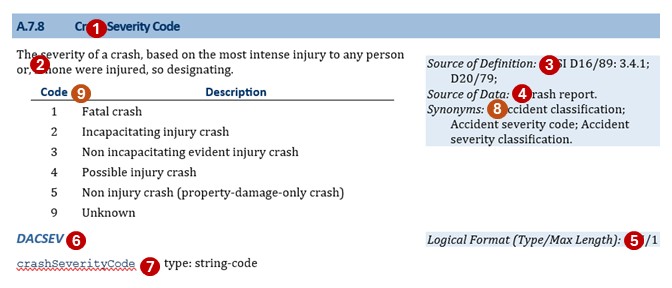
Each element includes:
- A clear name
- A business description of the element.
- The source definition, which describes where the definition came from.
- The source of data, which describes where the data originates.
- The logical format, provides a non-implementation definition of the data type and size. Types are: Date, Blob=Binary large object, N=Number, A=Letters, AN=Printable Characters.
- The element identifier is a six character code that may be used to reference an element.
- The implementation details include the label (the JSON tag) and the implementation format (the Data Types) used to identify the element in a given implementation.
When the following are applicable to an element they are also included:
- Synonym list other names by which the element may be known.
- Values and Descriptions list code values that are used on code elements.
- Usage Notes provide information on how the element is used (this is not shown in the example above because it is not applicable to the element).
Implementation Details
At the implementation level, the details of an element will vary according to the needs of the computer environment where the element is being used. AAMVA primarily supports implementations using the AMIE, NIEM and REST formats. REST was developed to provide a standard framework for elements using JSON. So the dictionary includes:
- The JSON tag used to identify the element. In JSON exchanges, fields belonging to a common group, will have a parent element for the group and the fields are then listed as child elements within the group. The tag names for elements, follow industry conventions and do not repeat the parent name in the child names, e.g. a Vehicle Length element will have a tag of "
length", under the "vehicle" parent:"vehicle": {"length": "123","width: "456",...} - The data type of the element.
JSON was defined to support certain data types. OpenAPI describes a JSON payload but it has some differences in the way it describes the data types. In AAMVA documentation, the type descriptions are extended to provide even more detail.
AAMVA Description |
OpenAPI |
JSON |
boolean: a true/false indicator represented as "true" or "false" |
boolean: a true/false indicator represented as "true" or "false" |
boolean: a true/false indicator represented as "true" or "false" |
number: a decimal number |
number: an integer or a decimal number |
number: an integer or a decimal number |
number-integer: a number without decimal places |
integer: a number without decimal places |
|
numericDate: a number of seconds since the Epoch date. Per IEEE 1003.1 standard. |
|
|
string: alpha numeric characters |
string: alpha numeric characters |
string: alpha numeric characters |
string-base64: String data that has been encoded as base-64. |
|
|
string-code: String data that holds a specified code value. |
|
|
string-date: String data that holds a date in |
string: and may include "format": "date" |
|
string-date-time: String data that holds a date-time stamp in ISO 8601 |
string: and may include "format": "date-time" |
|
group: a collection of sub-elements |
object: a set of name-value pairs, |
object: a set of name-value pairs, |
|
array: a set of repeating element(s). |
array: a set of repeating element(s). |
|
Null is not used (though a nullable attribute could be used). |
null: an empty element |
Note: the number data types are encoded with Arabic numerals.
Organization of D20 Data Elements
The D20 data elements are presented in this section. The D20 data elements are defined to be part of a data model. So related elements are grouped in their parent object. In this section, there is a sub-section for each object and its elements,, e.g. the data elements used to describe a motor vehicle crash are in the Crash sub-section.
The following diagram shows the groups used in this document and the primary relationships between the groups. The relationship lines have crow foot icons. The narrow end points to the parent and the splayed end the children.
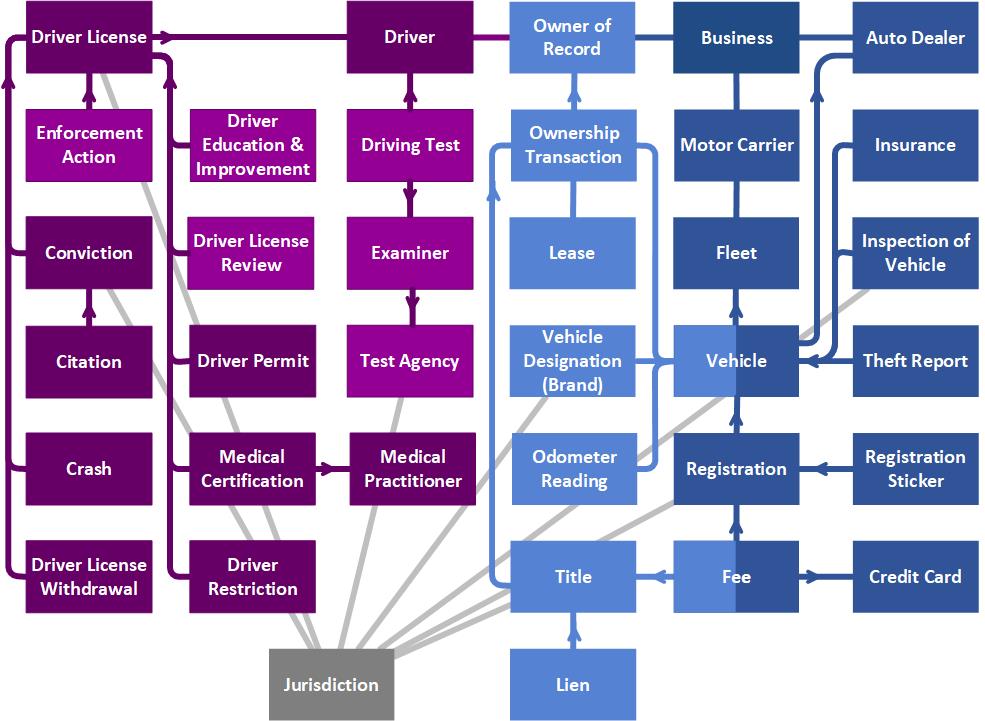
The shading indicates the business areas that primarily use these groups of data:
- Purple objects: Driver Licensing (i.e. AAMVA applications: CDLIS/SPEXS, CSTIMS & PDPS). Federal regulations identify data that belongs to the Driver Control Record, these objects are colored in dark purple.
- Blue objects: Vehicle recording, which is sub-divided
- Light Blue: Vehicle Titling (i.e. AAMVA applications: NMVTIS & e-Title)
- Dark Blue: Vehicle Registration (i.e. AAMVA applications: BPEVR)
|
AAMVA.org Who is AAMVA Contact AAMVA (helpdesk@aamva.org) System Availability |
AAMVA Terms of Service AAMVA - Official Use Only 2/18/2026 © AAMVA. All rights reserved. Book: 56261 Topic: 25324 |