
This award is presented to successful projects/programs developed and implemented in cooperation with public or private sector organization(s).
This is an agency award and is awarded one per each region and among those, an international winner is selected.
Each agency may submit only ONE entry.
Criteria for selection:
- Overall success of the project/program
- Opened or expanded dialog with another government agency or private sector organization
- Created efficiencies
- Increased convenience for governmental services to citizens or bridged gaps in service delivery
- Reduced costs by at least 10% for one or all government agencies involved and/or increased funding by 5% for the government agency
- Resulted in improvements for a group of citizens to function in society
- Serves as model for other jurisdictions
2026 Winners
International and Region 3
Minnesota Driver and Vehicle Services
Putting Customers in the Driver's Seat: Usability Studies Power DVS Innovation
Minnesota Driver and Vehicle Services (DVS) organized usability studies for its myDVS online portal to reduce the time customers spend visiting an office. Studies were conducted in November 2024 and April 2025, with a third planned for January 2026. The initiative brought together MN DVS Business Systems, the Minnesota Department of Public Safety Office of Communications, MN.IT@DPS, the MN FAST Enterprises team, LebsonTech, and Fieldworks. This strong partnership combined state and private-sector expertise to quickly identify and address issues affecting Minnesotans’ online experience.
The primary goal was to streamline high-volume transactions, including vehicle renewals, driver license pre-applications, and license reinstatement fee payments. Participants represented a variety of ages, education levels, and ethnicities, allowing DVS to understand how real customers—not just internal testers—interact with the system. During in-person sessions, participants completed tasks on desktops, tablets, and smartphones while explaining their thought processes. Moderators observed their experiences to identify design, navigation, and instructional elements that caused confusion or delays.
The feedback revealed opportunities to improve both functionality and the way information was presented. While all participants were able to renew their vehicle registrations without assistance, some were initially overwhelmed by the number of options or were unsure which documents they needed for appointments. Rather than waiting until after each study to make changes, DVS adopted a real-time approach that allowed the team to implement “quick wins” overnight and measure the impact during the next session. This approach allowed improvements to be tested and refined almost immediately.
The studies led to improvements in several areas. Menus were simplified to make navigation easier, while confusing industry terminology and error messages were revised with plain language in partnership with the Office of Communications. Alt text was added to images to improve accessibility for screen-reader users. The myDVS portal was also more clearly differentiated from the main DVS website after early participants reported accidentally navigating away from the portal, and the chatbot icon was repositioned so it no longer covered important content.
The initiative demonstrated the value of viewing services from the customer’s perspective rather than relying solely on staff familiarity with the system. By incorporating direct feedback from real users and making rapid improvements between sessions, DVS strengthened the convenience, accessibility, and customer focus of its online services. The enhancements have contributed to fewer calls and higher customer satisfaction, and the success of the initiative has inspired other state agencies, including the Minnesota Department of Revenue, to pursue similar usability efforts.
Region 1
Pennsylvania Department of Transportation
Remote Knowledge Testing Program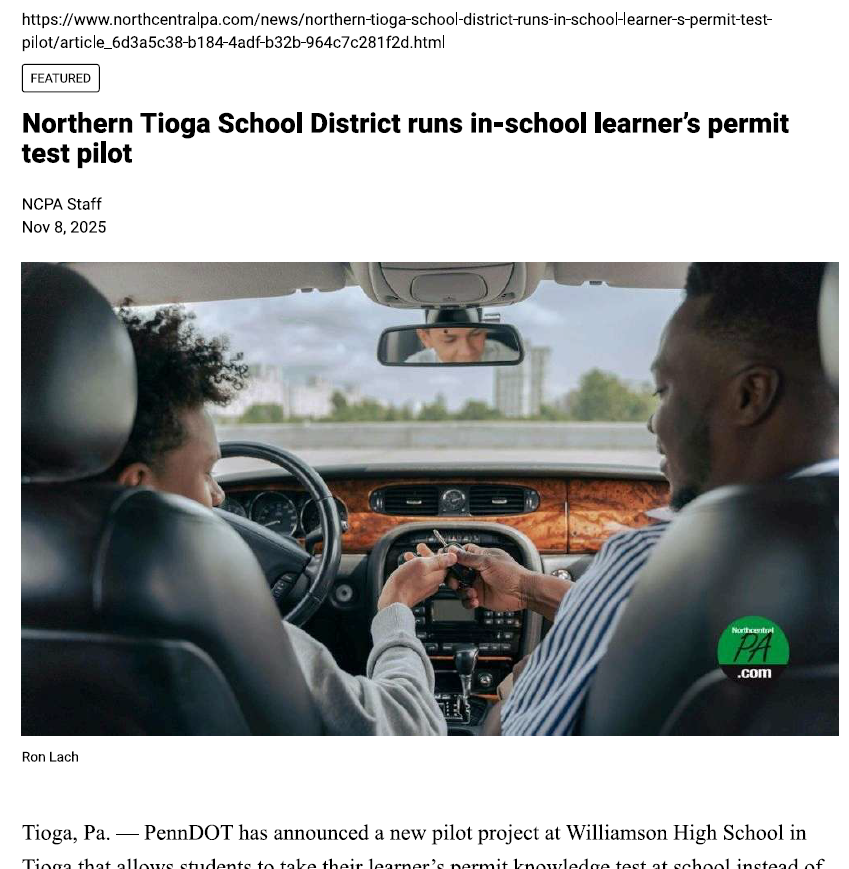
The Pennsylvania Department of Transportation (PennDOT), in collaboration with the Northern Tioga School District, launched a groundbreaking Remote Learner’s Permit Knowledge Testing Pilot to expand access to essential driver licensing services for students in rural communities. The pilot introduced a secure, proctored, remote testing environment within the school district, allowing eligible students to complete the non-commercial learner’s permit knowledge test without traveling long distances or taking time away from school to visit a PennDOT Driver License Center. This innovative initiative directly supports PennDOT’s mission to deliver equitable, customer-focused transportation services and represents a significant step toward improving accessibility, convenience, and safety for Pennsylvania’s future drivers.
Many Pennsylvania residents, particularly those in rural counties, face significant challenges accessing driver licensing services. In Tioga County, residents may need to travel long distances to reach the nearest PennDOT Driver License Center offering knowledge testing, and the center’s limited operating days can further complicate access. For high school students, these barriers can make obtaining a learner’s permit especially difficult for families with limited transportation options. Delays in obtaining a permit can, in turn, affect students’ ability to gain driving experience, participate in after-school activities, pursue employment, or access higher education opportunities that require reliable transportation.
Recognizing these challenges, PennDOT identified an opportunity to modernize service delivery through a secure, school-based remote testing model that would bring driver licensing access directly to students where they learn. The concept was shaped in part through direct engagement with students, whose experiences and feedback helped PennDOT understand the barriers they faced and identify a practical solution. The Remote Learner’s Permit Knowledge Testing Pilot launched in partnership with the Northern Tioga School District in September 2025. The pilot allows students age 16 and older to complete the PennDOT non-commercial learner’s permit knowledge test within their school environment using a secure, web-based platform and laptop.
The pilot has delivered meaningful benefits for students, families, and the broader rural community. Students in Northern Tioga County now have local access to learner’s permit testing without extensive travel or the need to miss school to visit a Driver License Center. Families save time and transportation costs, while the program advances PennDOT’s commitment to equitable service delivery by addressing access disparities in rural communities. Earlier access to testing also encourages students to begin the licensing process sooner, supporting driver education and preparedness and potentially contributing to improved safety outcomes for young drivers.
The initiative has also strengthened relationships among PennDOT, the Northern Tioga School District, and other community stakeholders, demonstrating how innovative public-sector partnerships can bring critical services directly to the people who need them. By listening to students and working collaboratively with local schools, PennDOT developed a solution that addresses a specific community need while maintaining the security, integrity, and regulatory requirements of state-administered testing.
The pilot represents a first-of-its-kind initiative in Pennsylvania and is among the few programs in the nation to deliver state-administered learner’s permit testing in a remote, school-based setting. It demonstrates that secure, technology-driven service delivery can expand access for underserved populations without compromising test integrity or compliance. The pilot’s success provides a blueprint for potential statewide expansion and offers a transferable model for other jurisdictions seeking to address rural service gaps through innovative, school-based partnerships.
Region 2
Service Oklahoma
Strengthening Reporting and Public Safety Through Partnership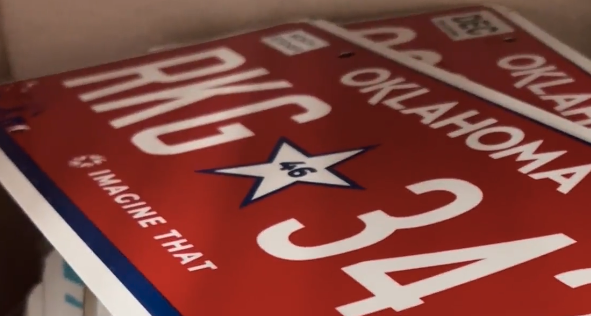
When Senate Bill 2035, known as the Mason Treat Act, went into effect on September 1, 2024, Service Oklahoma launched a new statewide pre-registration process for recently purchased vehicles. Under the new, quick, and secure process, all vehicles purchased through a dealership or private sale must be pre-registered with the state within two business days of purchase. The goal was to reduce the amount of time temporary paper tags remain on vehicles, improving road safety and accountability for both drivers and law enforcement.
Service Oklahoma implemented the new process within 90 days of the law’s passage, coordinating teams across technology, product, compliance, and communications. This rapid implementation established the foundation for a strong partnership with the Oklahoma Turnpike Authority (OTA), allowing vehicle data to be shared in near real time to improve toll accuracy, enforcement visibility, and customer service statewide.
Following implementation, Service Oklahoma and OTA expanded their partnership throughout 2024–2025 to fully integrate pre-registration and temporary tag data across both systems. Cross-departmental teams from both agencies worked together to develop secure data exchange processes, incorporate temporary tag information into OTA’s license plate reader network, and test new tools to ensure accurate billing for vehicles traveling Oklahoma’s turnpikes.
The results have been significant. Within one year, OTA saw an 88% reduction in temporary Oklahoma license plates, which before SB 2035 represented unbillable costs. In addition to recovering additional turnpike fees, OTA reduced mailing and administrative costs. The new data connection allows OTA to identify vehicles more accurately, bill the correct customers, and recover revenue that was previously lost because of missing or unreadable tags. The integration also provides law enforcement with more timely access to vehicle information, strengthening enforcement accuracy and improving overall road safety.
The collaboration between Service Oklahoma and OTA extends far beyond technical integration. Regular working sessions among the agencies’ IT, product, customer experience, and communications teams ensure that system updates, customer feedback, and data improvements are addressed collaboratively. Together, the agencies identified and corrected early address inconsistencies and refined customer record matching to ensure that registration and toll information is delivered to the correct individual on the first attempt. This ongoing collaboration has also strengthened communication between the agencies’ public information teams, enabling consistent messaging to customers and a unified response to media and public inquiries.
OTA now receives near real-time temporary tag information, improving toll processing and customer billing, while Service Oklahoma has achieved cleaner data across systems, reduced manual data entry, and enhanced coordination with law enforcement. The partnership demonstrates how collaboration and shared technology can strengthen public safety, improve government efficiency, and enhance the customer experience. By combining technical expertise, open communication, and a shared commitment to transparency, Service Oklahoma and the Oklahoma Turnpike Authority have created a sustainable model that other jurisdictions can replicate to modernize vehicle registration and tolling processes.
Region 4
Arizona Department of Transportation, Motor Vehicle Division
TeleMVD at the Ports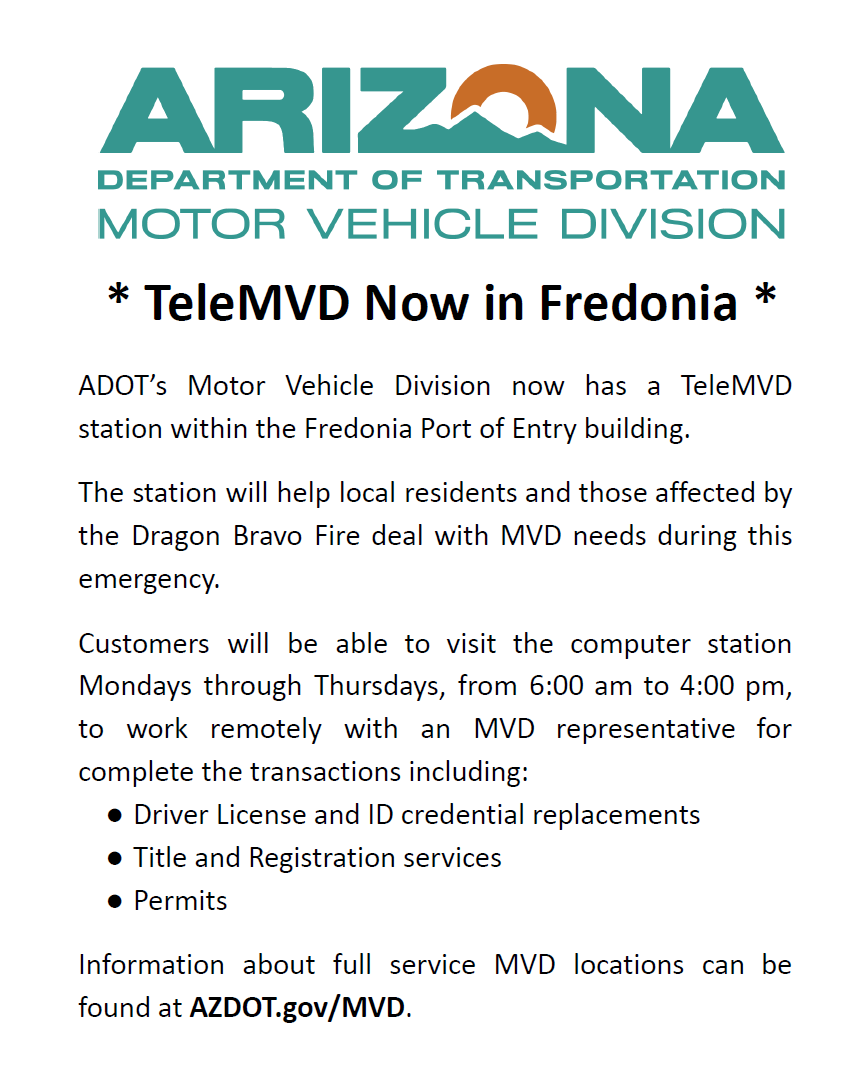
Residents in remote communities of Arizona previously had to travel up to two hours to access MVD services. To address this challenge, the Arizona Department of Transportation Motor Vehicle Division (MVD) partnered with Ports of Entry along Arizona’s borders to bring services closer to residents in communities where the volume of transactions was not sufficient to support a traditional MVD office and full-time staff. This innovative approach allows MVD to serve customers locally while using existing state resources and infrastructure.
In Fredonia, residents previously had to travel approximately one hour and 45 minutes to Littlefield or one hour and 20 minutes to Page for MVD services. Reaching either location required customers to cross into Utah and then back into Arizona. Residents in the Teec Nos Pos area faced similar challenges, traveling approximately two hours to Window Rock or an hour and a half to Chinle. While the transaction volume in these communities could not justify permanent MVD offices, the needs of their residents remained important, creating an opportunity for a more flexible service delivery model.
The need for the service became particularly urgent when the Dragon Bravo Fire north of the Grand Canyon closed the road to Page. Some residents affected by the fire were unable to access their homes or had lost important identification and vehicle credentials. In response, MVD collaborated with the Fredonia Port of Entry to establish a TeleMVD station and worked with the Fire Net Resource Center and the Arizona Department of Forestry and Fire Management to make affected residents aware that services were available.
With MVD equipment installed at the Port of Entry, customers can visit the location, receive assistance from an on-site enforcement officer, and connect by video with an MVD representative hundreds of miles away. The TeleMVD station allows customers to securely submit documents, have their photograph taken, make payments, and complete their transactions with an MVD representative guiding them throughout the process. All MVD driver and vehicle transactions, with the exception of road tests, are now available at the Fredonia Port of Entry.
The same innovative service model has been established at the Teec Nos Pos Port of Entry, an even more remote community. Customers can access a TeleMVD station and connect directly with an MVD representative, while on-site enforcement officers provide local support. In an additional step toward expanding access, staff at the Teec Nos Pos Port of Entry have been trained to administer skills tests, allowing customers to complete a road test locally rather than traveling hours to another location.
The TeleMVD initiative demonstrates how Arizona MVD can use technology, partnerships, and existing state infrastructure to provide essential services to residents who otherwise face significant geographic barriers. By bringing DMV services to remote communities rather than requiring residents to travel long distances, the program improves accessibility, increases customer convenience, and provides a flexible model for delivering services where traditional offices are not feasible.