Region 2
Georgia Department of Driver Services
Improving Safety with No Cost Solutions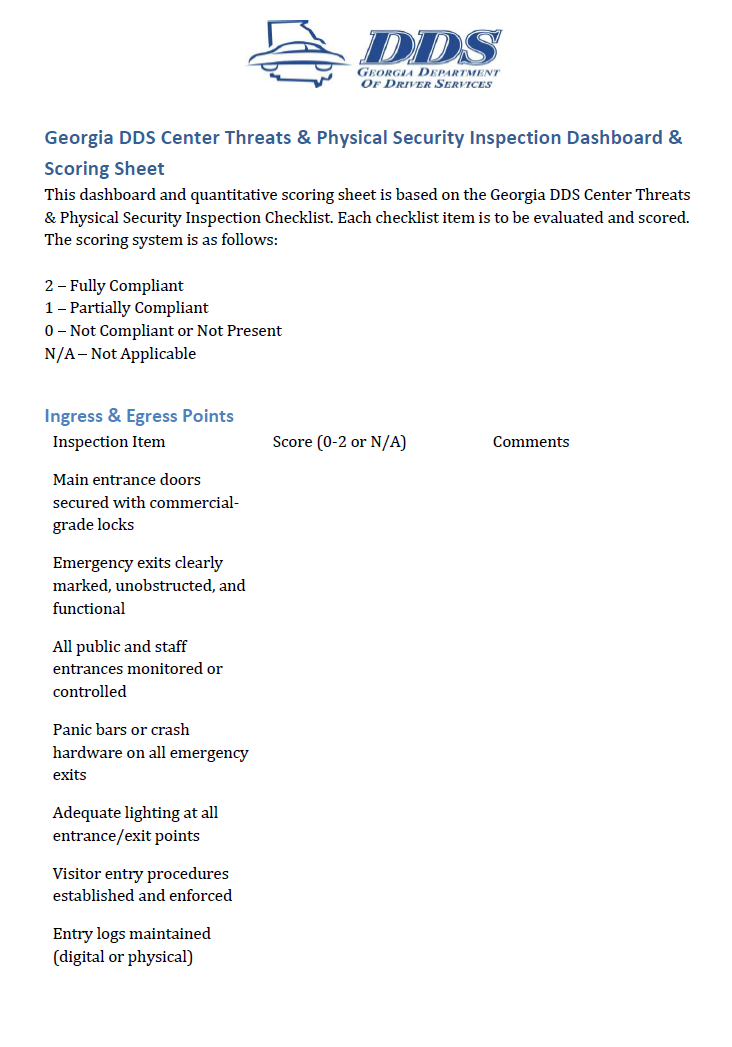
The Georgia Department of Driver Services (DDS) has strengthened its commitment to workplace safety by implementing practical, low-cost measures designed to protect employees and customers without adding manpower or weapons. Because DDS team members interact with the public every day, the agency recognized that training, awareness, emergency preparedness, and a secure work environment are essential to maintaining operational excellence and providing quality service to Georgia’s citizens.
The DDS Office of Investigative Services (OIS) has focused heavily on employee training and awareness, helping team members recognize potential threats, de-escalate tense situations, and respond effectively during emergencies. OIS hosted two safety-focused Lunch and Learn events in 2025, including Workplace Violence on June 23, attended by 90 employees, and Workplace Situational Awareness on September 15, attended by 87 employees. These efforts have helped strengthen employees’ understanding of potential risks and provided practical tools for responding to challenging situations.
OIS also conducts comprehensive safety assessments and audits of every DDS property, including public-facing Customer Service Centers. These assessments examine both internal and external conditions, identifying concerns ranging from uneven pavement and other physical hazards to emergency exit obstructions and potential responses to criminal activity on state property. The assessments have resulted in numerous improvements, including enhanced lighting, more secure entry points, improved visibility in public areas, and strategically placed barriers designed to deter unsafe behavior. Bullet-resistant materials and counter partitions have also been installed at front service counters to provide additional protection for employees and customers.
DDS has further enhanced security through expanded camera coverage and adjustments to existing cameras to ensure entrances, exits, and common areas are visible and recorded. Beyond improving overall safety, these systems assist with identifying suspects involved in fraud, investigating on-site vehicle accidents, and addressing incidents involving irate customers. The agency has also established partnerships with city and county law enforcement agencies to provide additional support when DDS offices require outside assistance.
Safety training has been tailored to individual facilities to provide employees with relevant, real-world preparation. Training includes active shooter response, recognition and mitigation of deviant behavior, and appropriate interactions involving individuals experiencing mental health challenges. Regular safety drills and policy reviews reinforce these practices, while the DDS Executive Team meets quarterly with regional center managers to ensure safety procedures remain consistent and that employees are prepared to respond effectively.
Through these efforts, DDS has fostered a strong culture of safety and created an environment where employees are encouraged to raise concerns and offer suggestions before issues escalate. By combining training, facility assessments, security improvements, community partnerships, and ongoing leadership engagement, DDS has demonstrated that meaningful improvements in workplace safety can be achieved through thoughtful planning, collaboration, and a shared commitment to protecting employees and customers.
Region 3
Indiana Bureau of Motor Vehicles
OPEX Technology Transforms Indiana BMV Service Delivery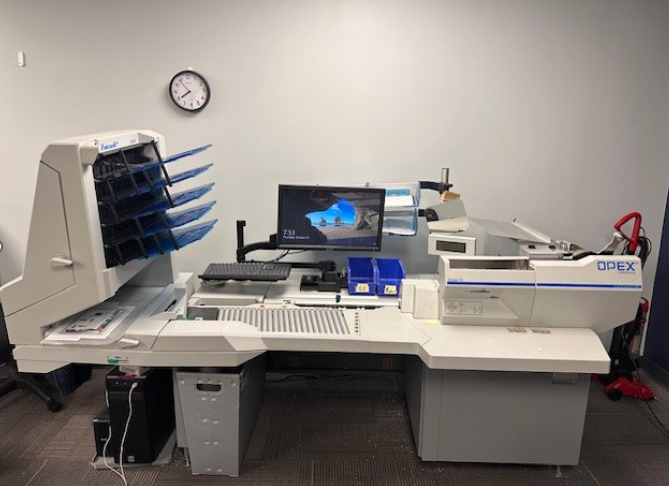
The Indiana Bureau of Motor Vehicles (BMV) implemented a transformative technology initiative at its Winchester Processing Center by leveraging an OPEX machine to automate customer registration renewals. The innovation integrates seamlessly with BMV systems and allows single pre-printed registration forms to be processed with minimal associate involvement, significantly improving service delivery and operational efficiency.
The OPEX machine has tripled processing speeds, allowing the BMV to complete up to 300 transactions per hour. This increased capacity reduces manual labor, minimizes paper handling, and improves turnaround times for Indiana residents. To date, more than 80,000 transactions have been processed through the system, with annual savings projected at $15,000 through reduced labor and increased throughput.
The initiative has improved the customer experience by accelerating registration processing and reducing wait times, while allowing the BMV to optimize staff resources and increase operational capacity. The project demonstrates how targeted automation can modernize public-sector services, improve efficiency, and provide a scalable model for other agencies seeking to leverage technology to better serve their customers.
Region 4
California Department of Motor Vehicles
Driver Safety Case Management System Modernization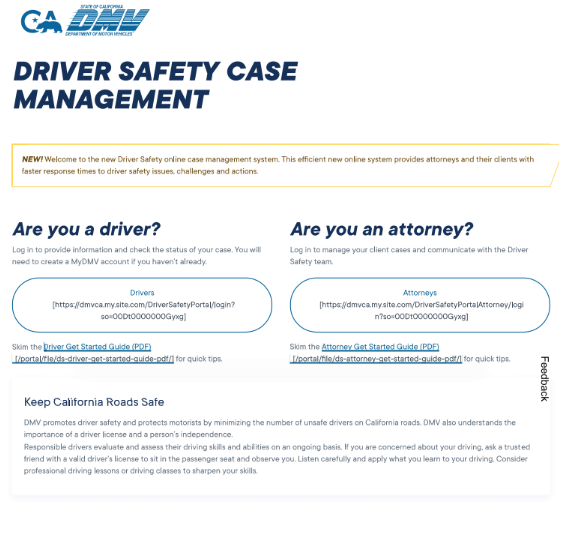
The Driver Safety Branch of the California DMV implemented a modern digital case management system that automates the processing of approximately 20,000 unsafe driver cases each month and supports the administration of roughly 1.4 million sanctions annually statewide. The system supports DMV driving privilege guidelines, schedules cases, and updates actions imposed on drivers facing violations, helping the DMV more efficiently maintain disciplinary records and keep unsafe drivers off California roads until they complete required corrective actions.
The system includes self-service Driver, Attorney, and Law Enforcement portals that allow users to submit information, schedule appointments, and upload documents electronically. These tools have replaced much of the previous paper-based workload by eliminating paper forms and automating case creation. The system can also separate unrelated incidents submitted in the same PDF and organize related documents, including arrest reports, sworn statements, traffic and accident reports, and chemical test reports, into the appropriate cases.
The digital case management system has eliminated the need for physical file rooms and overnight shipment of paper files. Records can now be shared seamlessly among 17 offices across California, reducing delays and allowing customers to schedule appointments with any available hearing officer statewide rather than being limited to officers in their local area. As more law enforcement agencies adopt the portals, the benefits continue to grow. When the system launched in February 2025, only two agencies were using it; by April, 30 agencies had adopted the system, with additional agencies continuing to join.
The modernization has produced significant operational gains. Average case life for the longest and most complex cases was reduced from more than 176 days to 78 days, allowing unsafe driver cases to be resolved more quickly and supporting safer roads. The DMV also implemented ABBYY to automatically process approximately 135,000 DUI reports annually, saving an estimated 8,662 personnel hours each year.
Digitized case records have improved accuracy by reducing manual data entry and giving staff real-time access to information. The system also provides greater transparency into case status, workload distribution, and deadlines, allowing managers to address issues proactively and improve efficiency. Digital case management has effectively connected Driver Safety offices statewide, enabling them to share workloads and reassign cases seamlessly for more consistent service and better use of resources.
Virtual hearing capabilities have further expanded the benefits by removing geographic barriers, increasing scheduling flexibility, reducing wait times, and allowing cases to be resolved more quickly. Together, these digital tools have replaced outdated, labor-intensive processes with a centralized and modern system that saves employees and customers significant time and resources while improving the DMV’s ability to efficiently administer driver safety programs across California.