
This award is presented to jurisdictions who have implemented technology tools that directly enhance access to services or the service experience.
This is an agency award and is awarded one per each region and among those, an international winner is selected.
Each agency may submit only ONE entry.
Criteria for selection:
- Technology is related to the delivery and improvement of service
- Quantitative data shows dollar return on investment, staff efficiencies, and/or increased adoption of electronic services
- Program demonstrates a measurable benefit to the public and the agency
- Program serves as an inspiration or model for further innovation
2026 Winners
International and Region 1
Maryland Motor Vehicle Administration
Mobile ID Check by MD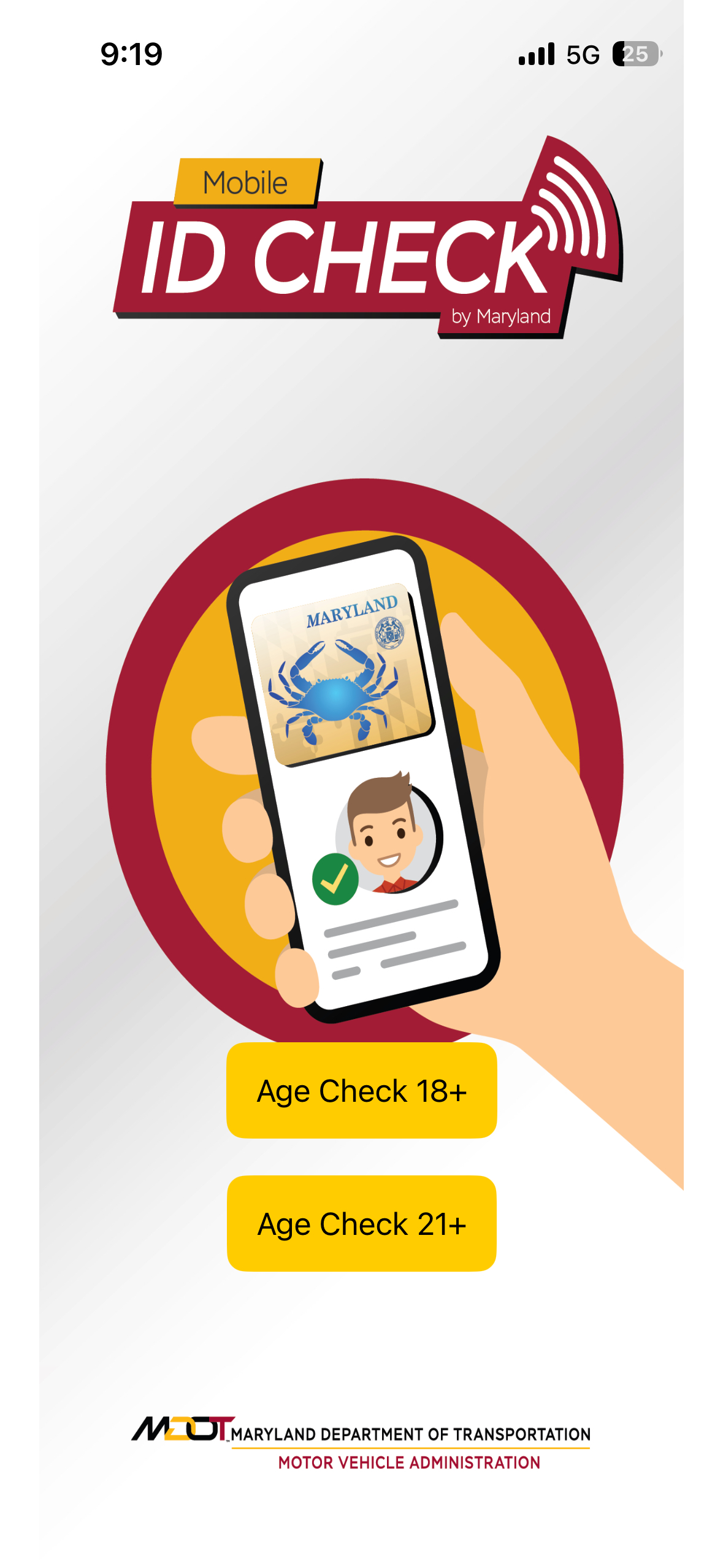
In 2024, the Maryland Department of Transportation Motor Vehicle Administration (MDOT MVA) introduced the Mobile ID Check by MD app, allowing businesses to verify mobile driver’s licenses (mDLs) and physical IDs using only a smartphone. Developed entirely in-house by MVA’s Information Technology team, the app reflects Maryland’s commitment to convenient, secure, and privacy-focused digital services while helping businesses transition to trusted digital identity.
The program was designed to meet growing demand for secure digital credentials and provide businesses with a simple, cost-effective way to verify identities without purchasing specialized hardware. As mDL adoption increases, retailers and service providers need tools that can quickly and accurately authenticate digital IDs, and Mobile ID Check by MD meets that need by using smartphones that businesses already have. The app follows international ISO 18013-5 security standards and protects user privacy by displaying only essential information, such as age confirmation and a photo.
The initiative improves the experience for both residents and businesses by reducing friction during identity verification. Residents can use an mDL instead of a physical card while maintaining greater control over the information they share, and businesses benefit from faster transactions and increased confidence in the authenticity of IDs without additional infrastructure costs. The app is already being used at Baltimore/Washington International Airport for alcohol purchases and launched with Montgomery County Alcohol Beverage Services at select retail locations, with plans for broader deployment across county-owned liquor stores and Merriweather Post Pavilion.
The app also delivers significant efficiency and return-on-investment benefits. Because it was built entirely in-house, Maryland incurred no vendor development costs, while businesses were able to avoid purchasing specialized hardware or software traditionally required for digital ID verification. The result is immediate cost savings for retailers, improved staff efficiency, and faster, more accurate identity checks that integrate naturally into existing workflows.
The measurable benefits include reduced exposure to fraud, stronger privacy protections, faster service delivery, improved customer experiences, and increased adoption of secure digital services. The initiative also supports Maryland’s broader digital government goals by demonstrating how innovative credentials can be implemented securely and equitably. Mobile ID Check by MD has already served as a model for other jurisdictions, with Maryland sharing the app’s code with three other states. By combining international security standards, zero-cost deployment, seamless business integration, and a strong focus on protecting personal information, Maryland has demonstrated how public-sector innovation can advance digital transformation while delivering tangible benefits to residents and businesses.
Region 2
Virginia Department of Motor Vehicles
ARTS: Reinventing the Road Test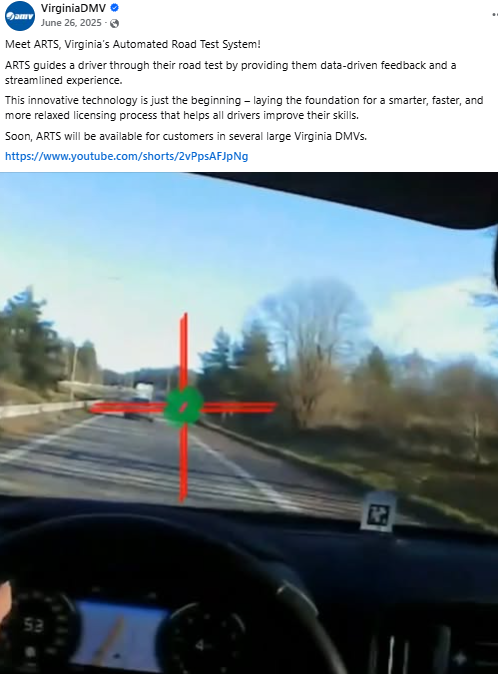
The Virginia Department of Motor Vehicles (DMV) is transforming the road skills test through the Automated Road Test System (ARTS), a fully autonomous system that uses an iPhone to conduct road tests with artificial intelligence, computer vision, robotics, and eye tracking. Instead of relying on a human examiner with a clipboard, ARTS provides a data-driven, objective testing experience that can be completed through a simple, self-guided process. The system is designed to be scalable and accessible while fundamentally changing a process that had remained largely unchanged for nearly 100 years.
Unlike basic telematics systems that simply track a vehicle’s location, ARTS actively monitors driver behavior, understands driving context, and determines compliance with traffic laws. It also provides detailed educational feedback, turning the road test into an opportunity for drivers to understand and correct mistakes while becoming safer and more confident motorists.
An 18-month paid pilot with Virginia DMV demonstrated the system’s accuracy and operational potential, with hundreds of road tests completed. ARTS matched human examiner decisions 97 percent of the time and never passed a driver who a human examiner had failed, maintaining a strong emphasis on safety and testing integrity. Examiners consistently praised the system’s precision, fairness, and consistency, while noting that it reduced stress for both customers and staff. The DMV Commissioner described the system as being “like having five examiners in the car.”
By replacing manual, paper-based testing with an automated digital process, ARTS reduces test times and administrative inefficiencies while allowing staff to focus on higher-priority customer needs. Shorter tests can help reduce wait times and enable DMV branches to serve more customers without sacrificing accuracy or objectivity. Because the system operates entirely through an iPhone, it also eliminates the need for expensive specialized equipment, dedicated hardware, or third-party testing contracts, making the solution cost-effective and scalable without significant additional infrastructure or staffing.
For customers, ARTS creates a faster, more convenient, and educational experience. Drivers receive real-time guidance and immediate digital results, transforming what can be a stressful and lengthy process into a streamlined, data-driven experience. The feedback provided during testing also helps new drivers understand their mistakes and develop safer driving habits.
Virginia DMV plans to roll out ARTS statewide in phases, beginning with high-traffic centers and gradually expanding customer access to the automated testing experience. Through ARTS, Virginia DMV has reimagined the road skills test, demonstrating how emerging technology can improve efficiency, objectivity, customer service, and roadway safety while establishing a new model for driver testing in the 21st century.
Region 3
Ohio State Highway Patrol
Automated License Plate Recognition (ALPR) Technology
The Ohio State Highway Patrol (OSHP) has made the use of technology a priority in its efforts to serve Ohio citizens and the motoring public, including significant advancements in Automated License Plate Recognition (ALPR) technology. OSHP has maintained a network of fixed ALPR cameras throughout Ohio for many years to assist with apprehending wanted individuals, recovering stolen vehicles, locating missing persons, supporting investigations, and enhancing safety on roadways and state-owned properties. Over the past year, this network has continued to expand and is increasingly shared with law enforcement partners across Ohio and throughout the country.
OSHP has also developed a unique partnership between its Licensing and Commercial Standards Unit and the Federal Motor Carrier Safety Administration (FMCSA). Through this partnership, ALPR captures can generate real-time alerts to Licensing and Commercial Standards personnel when they are near a commercial vehicle that may pose a safety risk or be subject to an out-of-service order. Alerts can be based on safety deficiencies or other FMCSA violations, allowing personnel to independently identify potentially unsafe commercial vehicles and improve the efficiency and effectiveness of commercial vehicle enforcement.
OSHP has also worked to quantify the impact of its expanding ALPR program. Since establishing a method to accurately track outcomes in August 2024, ALPR technology has helped initiate an incident or investigation in nearly 500 instances and contributed to the recovery of more than 100 stolen motor vehicles. During the same period, the Licensing and Commercial Standards Unit used the ALPR and FMCSA partnership to investigate nearly 250 commercial motor vehicles with potential safety violations.
As OSHP continues to expand its ALPR capabilities, the agency remains committed to collaborating with partner agencies and sharing resources and information. The measurable results demonstrate how innovative technology can enhance law enforcement operations, improve roadway safety, recover stolen vehicles, and ultimately have a positive impact on the communities OSHP serves.
Region 4
Nevada Department of Motor Vehicles
Faster Titles, Better Service: How eDS Improved Nevada DMV Operations
The Nevada Department of Motor Vehicles (DMV) has continued to improve the customer experience through its DMV Transformation Effort (DTE), which has brought many services online to make transactions faster and more efficient. One of the initiative’s most notable achievements is the DMV’s partnership with eDealer Services (eDS) to modernize the electronic title process for new vehicle sales. Within months of implementation, eDS reduced title processing times from several weeks to approximately three days.
eDS serves as an electronic hub connecting the DMV with third-party service providers for digital title and registration systems, including the Electronic Lien and Title (ELT) program. The goal was to create a faster, easier, and more accurate process while remaining budget neutral. Previously, paper titles and mail delays created significant processing times and frustration for dealers and customers. With the new system, dealers can submit title and registration information electronically to the DMV, creating a streamlined workflow that allows titles to be processed more quickly and efficiently.
The initiative benefits Nevada motor vehicle dealers, lienholders, and vehicle buyers. Dealers experience faster processing and fewer rejected titles, while lienholders gain real-time visibility into lien releases through the ELT network. Customers benefit from a smoother vehicle-buying experience and faster access to their titles. Since the launch of the online initiative, eDS has processed more than 93,000 titles, while the DMV has reduced the time required to ship physical titles to customers from 15 days to eight days.
The partnership has also generated significant internal efficiencies for the DMV. Manual handling of paper titles and mailed submissions has decreased substantially, reducing phone calls and resubmissions and allowing staff to devote more time to customer service and future system improvements. The initiative also achieved modernization without requiring taxpayer funding. By partnering with eDS, the system is self-sustaining, with costs absorbed by participating dealers and service providers rather than the public.
Through eDS, the Nevada DMV has demonstrated how technology and strategic partnerships can modernize government services while improving efficiency, reducing processing times, and creating a better experience for customers. The initiative provides a model for using innovative solutions to deliver faster, more accessible services while maintaining a budget-neutral approach.